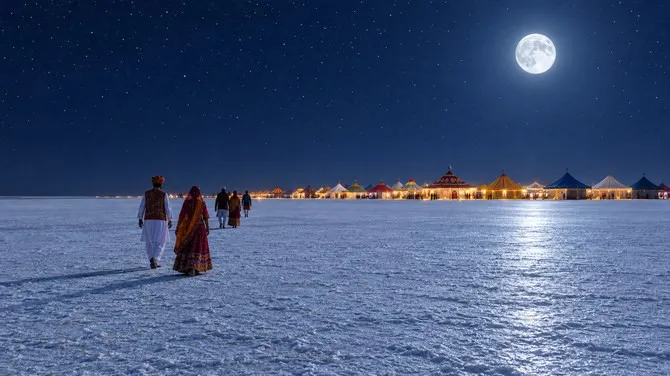
Rann Utsav, the winter festival that fills the white salt desert of Kutch with visitors, is already running. This year's edition opened on 1 November and continues until 7 March 2027, centred on the Tent City at Dhordo, beside the White Rann. But demand at the festival is not flat across those four months. It concentrates hard around the full-moon windows, when the salt flats glow under moonlight and the festival sells its most expensive nights, and around the Christmas and New Year stretch, which operators list as peak dates from mid-December to early January. The next full-moon window falls on 22 to 24 December, landing almost exactly on top of the Christmas holiday week. For independent hotels in Bhuj, the gateway city about 80 kilometres from the festival grounds, the next four weeks are the year's clearest booking window.
Understanding why Bhuj benefits starts with understanding the Tent City's limits. The official festival accommodation is a premium tented product with published tariffs that rise on full-moon and holiday dates, and its capacity, while large, is finite. Every peak window produces the same three kinds of overflow: families who find the Tent City sold out or priced beyond them, travellers who want the festival but prefer a conventional hotel with a conventional bathroom, and drivers, guides and tour staff who need practical lodging near the route. All three end up searching for rooms in Bhuj and the towns along the Dhordo road. The hotels that capture this demand are not the ones with the best rooms. They are the ones that removed the friction between a Bhuj room and a festival night.
Transport is the first friction to remove. Festival visitors plan around a simple question: how do I get from my bed to the White Rann and back, especially at night, when the moonlight visit is the whole point. A Bhuj hotel that answers that question in its listing and at its front desk, with a fixed-rate car arrangement, a shared shuttle partnership, or at minimum a reliable driver phone list, converts enquiries that a prettier lobby never would. Publish the transfer time honestly, around an hour and a half each way, and build packages around it: room plus return transfer, room plus transfer plus packed dinner. Guests comparing a complicated tent booking against a simple Bhuj package will often take the simple one.
The daily rhythm of a Rann guest also rewards small adjustments. Visitors leave for the festival in the late afternoon, stay through the cultural programmes and the moonrise, and return late. Breakfast matters more than dinner; make it early, generous and fast, because festival mornings start with sightseeing in Bhuj itself, from the Aina Mahal to the craft villages of Bhujodi and Hodka. Late checkout or at least luggage storage earns outsized goodwill, since most guests have an evening train or flight from Bhuj after their final festival day. Keep the front desk staffed, or at least reachable, for midnight returns, and say so when guests book. These are cheap promises that read as expertise.
Pricing for the full-moon weeks should be set now, not when the phones start ringing. Block the 22 to 24 December nights and the Christmas-to-New-Year stretch, set a two-night minimum if your market allows it, and publish a rate that reflects peak demand without inviting a festival-week reputation for gouging. The guests booking these dates include a large share of NRI families and group bookings made weeks ahead, which means the demand is visible early if your listing is findable and your answers are ready. Equally important: keep some inventory for the January and February full-moon windows, which operators list around 21 to 23 January and 19 to 21 February. The festival runs for four months, and the hotels that plan the whole curve, rather than reacting to the December spike, fill the quieter weeks around it.
Do not overlook the craft economy angle. Many Rann Utsav visitors come as much for Kutch's textile and craft villages as for the salt desert, and a hotel that can sketch a half-day craft route, or arrange a reliable guide, gives guests a reason to add a night in Bhuj on either side of their festival nights. Every extra night this season is earned at the desk, not the booking site.
The larger lesson is the same one festival towns teach everywhere: the event's official accommodation creates the market, and the surrounding city wins by being the practical alternative. Bhuj's independent hotels do not need to compete with the Tent City. They need to be the easy, honest, well-run option next to it, with transport solved, breakfast early and rates set before the rush. The moon does not wait, and neither do the guests. The December window is four weeks out. Set it up this week.
Sanskar Soni is the founder of Mehman, an India-first hotel management platform being built for independent and small-chain properties. He writes about the operational side of hospitality for small hotels.


