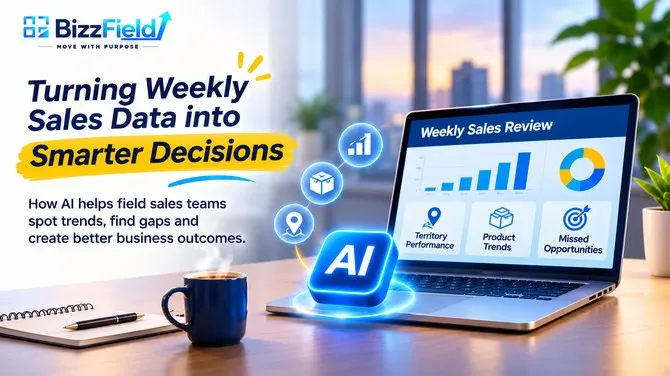
Field sales has always depended on people, relationships and a clear understanding of the market. Sales representatives visit retailers, distributors manage stock, and managers monitor targets across territories. But as businesses expand, keeping track of all these activities becomes increasingly difficult.
A typical sales manager may have to review outlet visits, order bookings, product movement, attendance records and distributor updates before understanding what is happening in the market. The information is available, but connecting the dots is not always easy.
This is where AI in field sales is becoming relevant. Rather than simply collecting more data, businesses are beginning to use technology to understand sales patterns, identify gaps and make better-informed decisions.
Why Traditional Field Sales Reporting Is Not Always Enough
Many organisations still depend on spreadsheets, phone calls and separate reports to monitor field operations. These methods may work for smaller teams, but they can become difficult to manage as the number of representatives, retailers and distributors increases.
Consider an FMCG company operating across several territories. A weekly report shows that sales have declined in one region. The numbers highlight the problem, but they do not necessarily explain the reason.
Were important retailers missed? Did product availability change? Are retailers ordering less frequently? Is the sales team facing difficulty covering its assigned beats?
Finding answers may require managers to check multiple reports and speak to different people.
A connected sales management system, supported by useful analytics, can make this process more organised.
4 Practical Ways AI Can Help Field Sales Teams
1. Better Visibility into Territory Performance
Sales performance is about more than achieving a monthly target. Outlet coverage, visit frequency, order conversion and representative productivity also matter.
AI-powered sales analysis can help managers examine these indicators together and identify territories that may need attention.
For example, a representative may be completing the planned outlet visits but generating fewer orders. This could indicate a need to review retailer engagement, product availability or the quality of sales conversations.
Instead of relying only on assumptions, managers get a clearer starting point for investigation.
2. Understanding SKU-Level Product Performance
Businesses dealing with multiple products often find it challenging to monitor SKU performance across different markets.
A product may sell consistently in one territory but move slowly in another. Local demand, retailer preferences, stock availability and ordering behaviour can influence these differences.
AI-based SKU analysis can help identify changes in product movement and highlight products or territories that deserve closer attention.
These insights can support conversations around inventory planning, product availability and sales priorities.
3. Identifying Missed Sales Opportunities
Some sales opportunities are lost quietly.
A regular retailer may not receive a planned visit. An outlet may reduce its order frequency. A representative may miss an important part of the assigned beat.
When field activity and sales information are stored separately, such patterns can be difficult to identify.
AI can analyse available sales and activity data to highlight unusual changes or potential gaps. Managers can then verify the information and decide what action is appropriate.
4. Improving Distributor and Secondary Sales Visibility
For distribution-led businesses, primary sales figures do not tell the complete story.
Companies also need to understand distributor inventory, secondary sales and retailer ordering patterns. Without this visibility, it can be difficult to understand how products are moving beyond the initial sale.
AI-enabled distribution analysis can help businesses review these indicators and identify patterns that need attention.
Better visibility also supports more meaningful coordination between sales teams, distributors and management.
Why Good Data Is Essential for AI SFA Software
Adopting AI does not automatically solve every sales management challenge. The quality of the available data remains important.
Outdated retailer records, incomplete visit entries and inaccurate order information can affect the usefulness of any analysis.
Before implementing AI SFA software, businesses should establish consistent processes for recording field activities, maintaining outlet information, updating product details and capturing distributor data.
The technology should also suit the realities of fieldwork. Mobile access and offline support can be valuable for representatives working in areas where internet connectivity is inconsistent.
The aim should be to make everyday work easier while improving the quality of information available to managers.
Choosing a More Informed Approach to Field Sales
Field sales management is gradually moving beyond basic activity monitoring. Businesses need to understand what is happening across their territories, why certain products are performing differently and where their teams may need support.
Solutions such as BizzField combine Sales Force Automation and distribution management capabilities with specialised AI agents focused on field sales activities, SKU performance, sales team performance and distributor management.
For organisations managing large field teams and distribution networks, this approach can help connect operational information with more useful insights.
AI should not replace the experience of sales managers or the relationships that representatives build in the market. Its role is to support better visibility and help people make more informed decisions.
Ultimately, successful field sales management is not about generating more reports. It is about understanding the information, asking the right questions and taking action where it matters.
Because knowing what happened is useful. Knowing what needs attention next is even more valuable.
Move With Purpose.
Explore BizzField: https://www.bizzfield.com/


