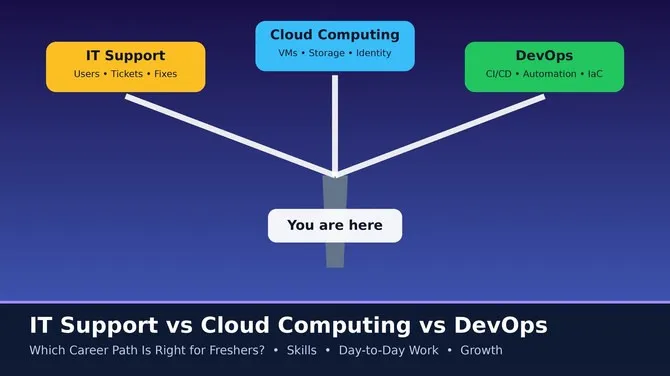
Choosing a first career direction in IT can feel confusing because each path has its own tools, expectations and growth routes. IT support vs cloud computing vs DevOps: which career path is right for freshers? This guide compares the three in simple terms, shows how they connect and helps you decide where to begin.
IT Support: The Most Accessible Entry Point
IT support engineers help users with devices, software, accounts and networks. The work is hands-on and people-focused, and it builds the troubleshooting base that other paths need.
-
Typical tasks: resolving tickets, setting up devices, managing accounts, supporting email and networks.
-
Core skills: Windows, networking basics, Microsoft 365, ticketing, communication.
-
Best for: people who enjoy helping others and solving problems.
Cloud Computing: Managing Modern Infrastructure
Cloud professionals create and manage servers, storage, networks and identity on platforms such as Azure, AWS and Google Cloud. Freshers often start in cloud support or junior administrator roles.
-
Typical tasks: deploying virtual machines, managing access, monitoring, backups and cost control.
-
Core skills: operating systems, networking, cloud fundamentals, scripting, security basics.
-
Best for: people who like infrastructure and enjoy learning platforms.
DevOps: Automating Delivery
DevOps engineers connect development and operations by automating how software is built, tested, deployed and monitored. It is rarely a first job for complete beginners, and many people reach it after experience in support, administration, cloud or development.
-
Typical tasks: CI/CD pipelines, containers, infrastructure as code, monitoring, automation.
-
Core skills: Linux, Git, scripting, Docker, Kubernetes, cloud, pipelines.
-
Best for: people who enjoy automation and systems thinking.
Comparison at a Glance
-
Entry difficulty: IT support is usually the most beginner-friendly; cloud is moderate; DevOps often needs prior experience.
-
Work style: support is user-facing; cloud is infrastructure-focused; DevOps is automation-focused.
-
Learning curve: support builds fundamentals; cloud adds platform knowledge; DevOps adds tooling and engineering practices.
-
Growth: all three can lead to senior engineering, architecture or management roles.
How the Paths Connect
A common progression is IT support to system or cloud administrator to cloud engineer to DevOps or site reliability engineer. Skills carry across: troubleshooting from support, networking and operating systems for cloud and automation for DevOps.
How to Decide
-
Do you enjoy working with people directly? Start with IT support.
-
Do you enjoy building and managing infrastructure? Consider cloud.
-
Do you like automation, scripting and engineering processes? Aim for DevOps, but build foundations first.
-
Check job listings in your city to see which entry roles are available.
A Safe Strategy for Freshers
Start in a role that matches your current skills, usually support or junior cloud, and learn the next layer in your spare time. For example, an IT support engineer can study Azure fundamentals, write PowerShell scripts and then move toward cloud administration.
Certifications to Consider
-
IT support: CompTIA A+, Microsoft fundamentals, ITIL Foundation.
-
Cloud: AZ-900, AZ-104, AWS Cloud Practitioner and associate certifications.
-
DevOps: Docker, Kubernetes and DevOps-focused cloud certifications, after you have practical experience.
Check each vendor's current exam information before booking.
Conclusion
There is no wrong first step, only the one that matches your skills and interests today. IT support builds foundations, cloud builds infrastructure expertise and DevOps builds automation power. Choose a starting point, keep learning and let your career grow along the path that suits you.


