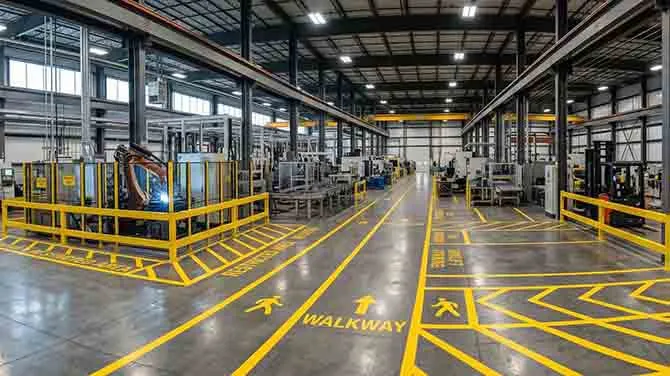
Industrial floor markings do not all face the same conditions. Lines inside a temperature-controlled warehouse may experience forklift traffic and repeated cleaning, while markings near loading docks and exterior entrances can also face tracked-in snow, moisture, salt, and changing temperatures.
For businesses considering Industrial Floor Marking in Burlington, the most important decision is whether the proposed marking system suits the actual conditions of each area. That decision should come before choosing paint or approving a repainting schedule.
Why one marking system may not suit every area
A typical industrial property contains several working environments.
Forklift travel lanes, pedestrian walkways, staging areas, shipping zones, and loading dock entrances may all experience different types of wear.
Consider two locations within the same facility.
A pedestrian walkway inside a dry storage area may experience regular foot traffic. A forklift route near a loading entrance may face frequent equipment movement, moisture carried indoors, and winter debris.
Although both areas require visible markings, their exposure conditions are different.
Using the same maintenance assumptions for every section can overlook these differences.
Before choosing a marking system, identify where traffic is concentrated, where moisture accumulates, and which sections experience seasonal changes.
This information helps determine which areas require closer attention.
What happens when snow and salt enter your facility?
Ontario winters can affect industrial floor markings even when most of the warehouse is indoors.
Forklifts and other vehicles may carry snow, slush, and road salt into receiving areas and loading zones.
As the snow melts, moisture can remain on the floor until it is removed or dries.
Repeated exposure to moisture, cleaning, and abrasive debris can contribute to marking wear. Salt residue may also complicate cleaning and surface preparation.
The effects depend on the floor material, existing coating, traffic conditions, and marking system.
For Industrial Floor Marking in Burlington, managers should pay particular attention to loading entrances, receiving areas, and transitions between indoor and outdoor working spaces.
These locations may require a different maintenance assessment from dry interior aisles.
The important question is not simply whether a line has faded. It is why that particular line is deteriorating.
Could MMA paint be a better option?
Methyl methacrylate (MMA) is a reactive resin system used in certain pavement and industrial marking applications.
MMA-based systems can offer relatively fast curing and strong wear resistance when correctly specified and applied under suitable conditions.
These characteristics make MMA worth researching for demanding environments where application downtime and durability are important considerations.
However, MMA is not automatically the best choice for every industrial floor.
Performance depends on factors such as:
- The specific MMA formulation and intended application.
- Compatibility with the existing floor substrate.
- Surface preparation and moisture conditions.
- Application temperature and ventilation requirements.
- Traffic exposure and the manufacturer's installation specifications.
Some MMA systems have particular application and ventilation requirements because of their chemical composition.
Facility managers should review the product's technical data and safety documentation before selecting a system.
MMA should also not be confused with ordinary traffic paint or assumed to be suitable for every indoor environment.
When is conventional traffic paint appropriate?
Not every industrial facility requires a specialized reactive-resin marking system.
Waterborne and solvent-based traffic paints may be appropriate for certain marking projects, depending on the surface, operational conditions, and product specifications.
For example, a facility seeking to refresh existing pedestrian boundaries may have different requirements from a heavily trafficked loading area.
The correct decision depends on the proposed paint's suitability for the floor and its expected exposure.
Before approving a project, ask which paint system is proposed, why it is suitable, and what preparation is required.
Easy Line Marking provides industrial and warehouse line painting using its confirmed traffic paint options, with site assessments to establish the relevant project requirements.
The goal should be to select an appropriate system rather than automatically choosing the most specialized or expensive material.
Why winter damage should change your inspection priorities
A facility manager may inspect all floor markings at the same time, but winter-exposed areas deserve particular attention.
After periods of snow and freezing weather, inspect the areas near loading doors and exterior access points.
Look for worn boundaries, peeling or damaged markings, accumulated residue, and sections where water regularly collects.
Also examine whether forklift travel patterns or storage arrangements have changed.
A line that remains visible may still be positioned incorrectly for current operations.
For managers arranging Industrial Floor Marking in Burlington, separating surface deterioration from layout problems helps establish a more accurate project scope.
What should happen before new markings are applied?
Successful marking work begins with understanding the floor.
A site assessment should consider existing markings, approximate dimensions, surface condition, traffic flow, and operational requirements.
Preparation is also important.
Confirmed preparation activities include cleaning dirt, dust, and debris, removing loose materials, ensuring the surface is dry, and measuring the proposed markings.
Masking or chalking guides may be used where required.
Easy Line Marking can assess the intended marking scope and discuss the preparation and scheduling requirements associated with its services.
For active warehouses, phased scheduling may be considered to reduce operational disruption.
The decision that matters before the next winter
When evaluating Industrial Floor Marking in Burlington, do not treat every worn line as the same maintenance problem.
A faded pedestrian boundary in a dry aisle, a damaged forklift lane, and a marking near a snow-exposed loading entrance may require different decisions.
Start by identifying the conditions affecting each area. Then establish whether the existing layout remains appropriate and which confirmed marking system is suitable.
Research MMA when specialized durability or curing requirements justify comparing alternatives, but verify product compatibility and contractor capabilities before making a selection.
Easy Line Marking supports Ontario industrial properties with warehouse floor marking, pedestrian walkways, forklift lanes, staging zones, and other designated operational markings.
The most practical marking plan is one based on real floor conditions, operational requirements, and seasonal exposure—not simply the appearance of the existing paint.
Learn more at Easy Line Marking


