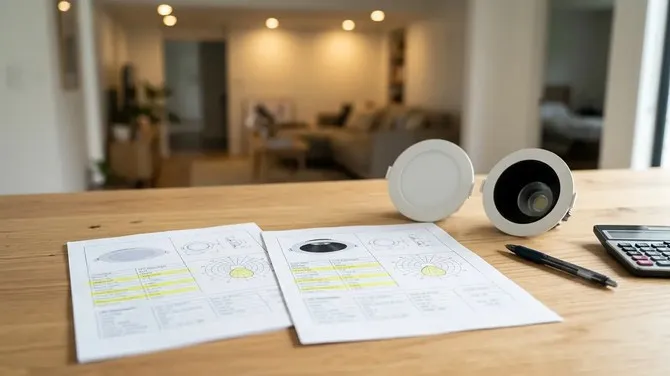
Anyone who has shopped for LED lights knows the moment. Two downlights sit side by side on the shelf or in a catalogue. They look almost identical, both say "warm white", both use the same wattage, and yet one costs several times more than the other. Most buyers choose the cheaper one and assume the difference is just the brand name.
Often, it is not. The real difference is printed on a document most people never read: the specification sheet. Learning to read a few key lines on it can save money, prevent disappointment and make a home look noticeably better.
The first line to check is light output, measured in lumens. Many people still compare lights by wattage, a habit left over from old bulbs. With LEDs, wattage only tells you how much power a fitting uses, not how much light it gives. Two fittings with the same wattage can produce very different amounts of light, so lumens are the fairer comparison.
The second is colour temperature, shown in kelvin. Lower numbers, around 2700K to 3000K, give a warm, cosy light that suits living rooms and bedrooms. Around 4000K feels neutral and works well in kitchens, study areas and home offices. Higher numbers feel cool and bright, which can seem harsh in living spaces at night.
The third, and perhaps the most overlooked, is the colour rendering index, or CRI. This measures how naturally a light shows colours compared with daylight. A light with a CRI of 90 or above makes skin, wood, fabric and paint look true to life. Cheaper lights with lower CRI can make a freshly painted white wall look slightly grey or green, and food on the dining table look dull. Because the difference is subtle in a shop but obvious at home, it is one of the most common sources of regret.
Several other lines are worth a quick look:
- Beam angle shows how widely light spreads. Narrow beams suit artwork and accents, while wider beams suit general lighting.
- Glare rating, often shown as UGR, indicates how comfortable a fitting is to sit under. Lower values mean less glare.
- The IP rating shows protection against dust and water. Bathrooms, balconies and outdoor areas need higher ratings than living rooms.
- The driver is the power supply inside every LED fitting. A good-quality driver reduces flicker and helps the light last longer.
- Dimming information tells you whether the fitting can be dimmed, and by which method, so it works with your switches or control system.
- Lifespan and warranty show how long the manufacturer expects the light to perform well, and how confident they are in it.
Once these lines are familiar, comparing two quotes becomes much easier. Line them up side by side and check light output, colour temperature and CRI first, then glare, protection, driver quality and warranty. Price makes sense only after that. If a supplier cannot provide a complete specification sheet, it is worth asking why.
None of this means the most expensive light is always the right choice. A storeroom or utility area does not need the same specification as a living room or a reading corner. The goal is to spend where it matters most, in the rooms where people spend their evenings, and save where it does not.
For homeowners who want a more detailed, line-by-line explanation of each value and how it affects price, this guide on how to read a lighting specification sheet covers the topic further.
Good lighting is not about the brightest or cheapest option. It is about choosing light that looks right, feels comfortable and keeps performing for years. The specification sheet is where that choice really begins.
Disclosure: The author works with Brightmatic, a lighting and home automation company that publishes the guide referred to in this article.