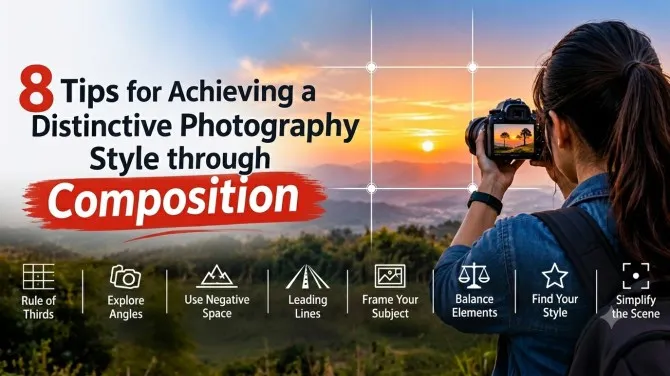
Photographers often aim to create pictures that feel unique and leave a lasting impression. While lighting, camera settings, and editing are crucial, composition is perhaps the most powerful way to develop a distinctive photography style. It guides what to include in your frame, where to position your subject, and how to direct the viewer’s attention.
The best compositions often come from experimenting beyond the usual rules. It also involves experimenting, noticing the little details, and finding what best expresses your creative vision. Here are eight helpful tips to help you develop your personal photography style through composition.
1. Understand the Rule of Thirds
The rule of thirds is a straightforward technique that can enhance your photographs' balance and interest. Think of your frame as a grid with three rows and three columns. Position your main subject along these lines or at their intersections. This approach works well in various photography styles, including portraits, landscapes, and street photography. Once you're comfortable using the grid, experiment with different compositions and see how each one changes the feel of your images.
2. Experiment with Different Angles
Always shooting at eye level can make your photographs feel predictable. Try experimenting with lower angles, overhead views, or different positions around your subject. A change in perspective can completely transform how a scene looks and feels. For example, shooting from below can make your subject appear more powerful. An overhead shot can bring out interesting patterns and shapes. Exploring new angles not only enhances your creativity but can also shape your unique photography style.
3. Use negative space creatively.
It helps your subject stand out by leaving enough open space around it. Leaving some breathing room around your subject can help reduce distractions and give your photograph a simple, polished look. This technique shines in portrait, product, and minimalist photography, helping create a specific mood and letting viewers focus on the subject without distractions.
4. Pay attention to the leading lines.
Leading lines are natural or created lines that steer the viewer's gaze towards the main subject. You can find these on roads, pathways, fences, buildings, and even shadows. Using leading lines effectively can bring depth and a sense of direction to your photographs. Take time to observe your environment and notice how lines connect elements within a scene. With practice, you’ll discover inventive ways to use them in everyday photography.
5. Explore Symmetry and Patterns
Symmetry and recurring patterns can make your photographs more visually captivating. They are all around us, especially in architecture, nature, reflections, and everyday scenes. When working with symmetrical scenes, try placing your subject in the center. Alternatively, you can break a pattern by introducing a contrasting element. This subtle change can draw attention and give your photograph a more substantial visual impact.
6. Learn to Frame Your Subject Naturally
Natural framing is another effective composition technique. Look for elements such as windows, doorways, branches, or arches to frame your subject creatively. This technique adds depth to your composition and helps the main subject stand out. It helps establish a sense of place and creates a more thoughtfully arranged image.
7. Focus on Balance and Visual Weight
A well-composed photograph doesn’t have to be perfectly symmetrical. Sometimes, placing a larger subject on one side and a smaller element on the other can create an intriguing balance. Pay attention to the colours, shapes, light, and size of objects within your frame. Understanding visual weight allows you to arrange these elements harmoniously without overwhelming the viewer.
8. Develop Your Style Through Regular Practice
Cultivating a distinctive photography style takes time and effort. Rather than mimicking every trend, experiment with different compositions and identify what resonates with you. Look back at your photographs, compare your work, and recognise patterns in how you frame your subjects. You may find that you prefer simple compositions, unusual angles, strong symmetry, or innovative uses of negative space. Keep practicing and let your personal preferences guide your creative choices.
Conclusion
Composition is more than just placing elements within a frame; it's a way to express your creativity, share ideas, and show the world from your perspective. By experimenting with angles, leading lines, negative space, symmetry, and balance, you can gradually develop a style that feels authentic and unique to you. Remember that while photography rules can serve as helpful guidelines, they shouldn't constrain your creativity. Continue observing, practicing, and exploring new techniques. Over time, your photographs will begin to reflect your distinct visual identity.
Frequently Asked Questions (FAQ)
1. Why is composition important in photography?
Composition helps organise the elements within a frame, creating a clear visual flow and making the photograph more engaging.
2. How can I develop my own photography style?
Experiment with different composition techniques and angles, and review your photos to identify what resonates with you. Build on those preferences for a unique style.
3. Is the rule of thirds necessary for every photograph?
Not necessarily. While the rule of thirds works well in many situations, centred composition and symmetry can be better choices for certain scenes.
4. How does negative space improve a photograph?
Using negative space helps highlight the subject and gives the composition a sense of simplicity and openness.
5. Can beginners learn creative composition techniques?
Absolutely! By learning basic techniques like the rule of thirds and leading lines, beginners can gradually develop a better eye for composition.


