Wiper blades may look like simple automotive components, but managing their fitment information can become complicated. Many vehicles require different blade lengths for the driver and passenger sides, while some also need a separate rear wiper blade. Connector styles and vehicle-specific requirements add another layer of complexity.
For automotive manufacturers, distributors, and online parts sellers, organizing this information correctly is essential. Accurate fitment data helps customers identify compatible products and reduces confusion during the buying process.
Why Are Wiper Blade Combination Fitments Challenging?
A wiper blade combination usually includes multiple blades designed to work together on a particular vehicle.
For example, one vehicle may require:
-
Driver-side wiper blade: 26 inches
-
Passenger-side wiper blade: 18 inches
-
Rear wiper blade: 12 inches
These blades may be sold individually, as a front pair, or as a complete three-piece set. Each product needs the correct vehicle application and installation position.
Without properly structured fitment information, sellers may experience incorrect product listings, compatibility issues, and unnecessary customer returns.
Important Details in Wiper Blade Fitment Data
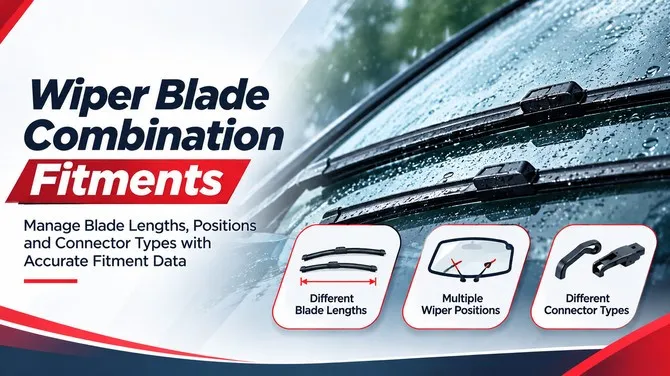
1. Different Blade Lengths
Driver-side, passenger-side, and rear wiper blades can have different measurements. Even a small mismatch in blade length can affect compatibility. Each blade should be mapped using its correct dimensions.
2. Multiple Wiper Positions
Wiper positions must be clearly identified in the product data. Common positions include Front Left Driver, Front Right Passenger, and Rear. Correct position mapping helps ensure that the right blade appears for the intended application.
3. Different Connector Types
Wiper blades are available with different attachment mechanisms, including J-Hook, Pinch Tab, Top Lock, Bayonet, Side Pin, and MultiAdapter. Recording the correct connector information is important when determining whether a blade can be installed on a particular vehicle.
4. Vehicle-Specific Applications
A product should be associated with the correct year, make, model, and other applicable vehicle details. Inaccurate vehicle mapping can result in products appearing in irrelevant search results or being excluded from compatible vehicle listings.
How ACES Data Helps Organize Wiper Blade Combinations
ACES data provides a structured way to communicate automotive part fitment information. For wiper blade combinations, important details include installation positions, connector types, blade dimensions, and vehicle applications.
Using the appropriate attributes and position information helps businesses organize product relationships more consistently.
Incorrect position codes, incomplete connector details, or inconsistent data formatting can create problems when preparing fitment files for marketplaces and other distribution channels.
Managing Wiper Blade Combinations More Efficiently
Managing combination fitments through spreadsheets can become difficult when a catalog contains hundreds or thousands of products. Repeated data entry, inconsistent formats, and manual validation can increase the possibility of errors.
A structured fitment management process can make this work easier.
Businesses can improve their workflow by:
-
Organizing driver, passenger, and rear blade information separately.
-
Linking multiple blade SKUs under a combination group.
-
Mapping parent SKUs to the appropriate vehicle applications.
-
Maintaining consistent connector and position attributes.
-
Validating fitment information against the latest VCdb and PCdb.
-
Preparing structured ACES XML files for distribution.
How PCFitment Simplifies Wiper Blade Combination Mapping
PCFitment helps automotive businesses manage complex wiper blade combination data through structured fitment management capabilities.
Users can organize driver, passenger, and rear blade positions, select relevant connector types, and group multiple blade SKUs under a parent product. The platform also supports mapping parent SKUs to matching vehicle applications.
Fitment data can be validated against the latest VCdb and PCdb, helping businesses identify data inconsistencies before distribution. Once prepared, the information can be exported as ACES XML or synchronized with supported marketplaces such as Amazon, eBay, and Walmart.
This approach helps businesses maintain organized product catalogs and manage complex wiper blade applications more efficiently.
Conclusion
Wiper blade combination fitment involves more than matching a product with a vehicle. Blade dimensions, installation positions, connector types, and vehicle-specific applications all play an important role.
Maintaining accurate and structured fitment data helps automotive businesses improve catalog organization, reduce compatibility-related errors, and provide customers with more reliable product information.
With a systematic fitment management process and tools like PCFitment, managing complex wiper blade combinations can become more organized and efficient.


