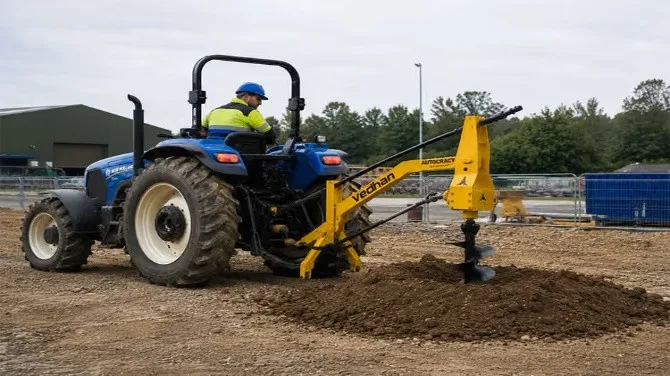
Three very different jobs share one requirement: a vertical hole, of consistent diameter, at a repeatable spacing. That is the whole case for a tractor-mounted post hole digger. It is not about digging faster in the abstract. It is about producing the same hole two hundred times, so everything that follows lines up.
Fencing makes the point most clearly. Posts spaced at two to three metres along a boundary need holes of roughly 150 to 200 mm, taken down 600 to 900 mm depending on wind load and soil. Hand digging those holes takes fifteen to twenty minutes each and leaves the diameter slightly different every time, which is why fence lines wander and posts loosen after the first monsoon. An auger cuts a clean cylinder in a fraction of that time, and the wire ends up straight because the holes did.
Solar mounting raises the stakes. Ground-mounted arrays need piles or legs set on a fixed grid, and a single hole off position forces the rail or module to be shimmed. On a multi-megawatt site the hole count runs into the thousands, so the difference between a manual crew and a tractor auger is measured in weeks rather than hours. Diameter and depth have to follow the structural drawing, which is why hydraulic downforce matters on hard, compacted ground.
Utility poles and route markers follow a corridor rather than a grid, but the demand is the same. A pole base wants a hole sized to the butt, not one widened by hand until it fits, and fibre route markers need shallow, uniform holes at regular intervals along a right of way. Alignment along the corridor is the quality measure.
Plantation and landscaping work sits at the smaller end: tree pits, irrigation supports, garden fencing. Fewer holes, softer ground, and a tolerance for a slightly wider opening, which makes it the easiest place to start with an auger.
Conclusion
The cost of a badly placed hole rarely shows up at the hole. It appears later as a raked post, a shimmed rail, a re-drill, or a concrete collar poured to correct a lean. Multiply that correction across a route and the labour saving from hand digging disappears.
Before choosing an attachment, count the holes, measure the hardest ground anywhere on the route, and decide the largest diameter you will actually need. Sizing from those three numbers is more reliable than sizing from a brochure.


