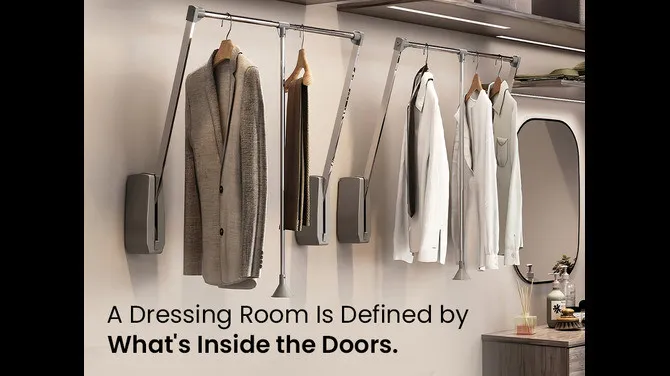
A beautifully designed walk-in wardrobe can have warm wood finishes, fluted glass panels, and a striking central island. But the real distinction between a luxurious dressing room and an oversized cupboard is often found behind the doors. The interior accessories determine how comfortably the wardrobe works every day—and these practical details are not always the ones that appear in design photographs.
For a truly functional luxury walk-in wardrobe design in India, the storage needs to do more than look refined. It should make clothing, accessories, and footwear easy to reach, organize, and maintain. Here are the details that elevate a wardrobe from impressive cabinetry to a thoughtfully planned dressing space.
1. Make Every Inch of Full-Height Storage Accessible
Full-height cabinetry is an excellent way to maximize vertical storage. However, the highest shelf can quickly become difficult to use. It may be visible and technically accessible, but reaching it can require a step stool and unnecessary effort.
A garment lift solves this problem by bringing the hanging rail down to a comfortable viewing and access height. Hettich’s Duo Lift, from German engineering firm Hettich, is available in different weight capacities depending on the model and cabinet width. With a simple operation, the rail can be lowered instead of requiring the user to reach awkwardly into the upper section.
This makes the otherwise underused upper storage zone practical. With solutions from Hettich India, full-height wardrobes can be designed to provide both maximum storage and everyday accessibility.
2. Keep the Wardrobe Island Organized
A dressing-room island can create a boutique-like experience, but its drawers need to be planned carefully. Without suitable compartments, even the most attractive island can become a place where jewellery, watches, and sunglasses are left in a disorganized pile.
Shallow drawers with soft-close functionality help maintain order. AvanTech YOU and InnoTech Atira drawer systems, available with Actro YOU runners in different load classes, can provide a structured way to organize smaller personal items.
Each accessory can have its own designated space, making it easier to find what is needed while keeping the island visually uncluttered. This is where premium wardrobe hardware contributes directly to the experience of using the room.
3. Keep Trousers Neat and Easy to Select
Folded trousers often become disorganized when stored in stacks. A neatly arranged pile can collapse as soon as one pair is removed, making it difficult to see what remains and requiring repeated rearrangement.
The Cargo Trouser Pull Out offers a more structured alternative. It can hold up to 11 pairs in a 600mm carcass and 17 pairs in a 900mm carcass. Each pair remains visible and upright, allowing users to select trousers without digging through a pile or disturbing the rest of the collection.
This accessory makes a practical difference in everyday wardrobe organization, particularly when several pairs need to be stored within a limited space.
4. Bring Shoes Forward Instead of Bending and Searching
Shoes stored on low shelves can be inconvenient to access, especially when they are placed deep inside a cabinet. In a 600mm-deep wardrobe, footwear pushed to the back may become difficult to see and can remain forgotten until the storage is reorganized.
The Cargo Pull Out Shoe Rack helps solve this issue by bringing footwear forward when needed. At 500mm deep, it accommodates at least 4 pairs at 600mm width and 6 pairs at 900mm width.
Instead of bending repeatedly or searching through the back of a shelf, users can pull the rack forward and view their footwear clearly. This is a practical example of walk-in closet organization improving both access and visibility.
5. Use Glass Fronts to Add Depth and Refine the Interior
Tinted, smoked, and fluted glass fronts can make a wardrobe feel more layered and visually sophisticated. They add depth while softening the view of the items stored behind them. In cities where dust can be a constant concern, this subtle visual screening can also be a welcome design advantage.
Glass panels need suitable sliding hardware, particularly when the panels are heavier. The weight of the glass should be considered when selecting the track and fittings.
When lighting is integrated behind or within the glass, the wardrobe can develop a gentle glow that enhances the dressing-room atmosphere. This is an example of dressing room architecture where appearance and technical planning need to work together.
6. Put Lighting Exactly Where It Is Needed
Dark wardrobe interiors can make it difficult to distinguish similar colours. Navy may appear black, and selecting the right outfit can take longer than necessary, especially during busy mornings.
An illuminated wardrobe rail, such as the LED Wardrobe Tube, can address this issue by placing light directly inside the hanging area. With motion detection and automatic shut-off, the light activates when the door opens and switches off when it is no longer needed.
Rather than illuminating the room vaguely from outside, the rail provides light precisely where the user is looking. This makes clothing selection easier and more convenient.
7. Preserve the Look of Warm Minimalism
A carefully chosen palette of rich veneers and restrained colours can create a calm, minimalist wardrobe. However, a bulky metallic handle can interrupt the overall look and draw attention away from the design.
Concealed-runner, handleless drawer profiles help maintain a clean visual line. They support custom closet ergonomics while allowing the hardware to remain discreet.
The result is a wardrobe where functionality is integrated into the design instead of becoming a visible distraction.
Plan the Accessories Before the Cabinetry Is Completed
Even the best wardrobe accessories can become difficult to integrate if they are specified only after the carpenter has finished the cabinetry. Rails, drawers, and tracks should be planned during the design and CAD stage so that the required clearances and fittings are included from the beginning.


