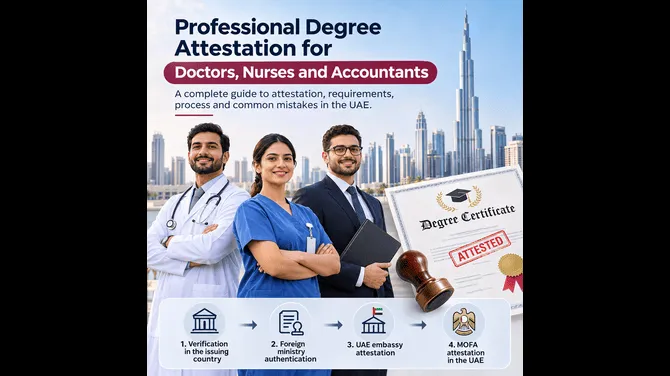
A job offer from a Dubai hospital or an Abu Dhabi audit firm is exciting, until the HR team asks for an attested degree. Your qualification must be legally recognized before a licence, work permit or professional registration can move forward.
This guide explains how professional degree attestation works for doctors, nurses and accountants and where applicants commonly lose time.
What Professional Degree Attestation Means
Attestation is a chain of official confirmations. Each authority verifies the previous authority's stamp, until the UAE Ministry of Foreign Affairs (MOFA) adds the final one. The UAE Government portal describes attestation as verifying the authenticity of a stamp and signature on a document, whether issued inside or outside the country.
A professional degree is one that leads to a regulated career, such as an MBBS, BDS, BSc Nursing, Pharm.D or a commerce degree in accounting. Medical degree attestation and nursing certificate attestation follow the same legal chain as any other degree certificate attestation in the UAE, but are examined more closely because they support a licence to practice.
Why Doctors, Nurses and Accountants Need It
Healthcare professionals
Healthcare staff need a licence from the regulator in the emirate where they will work. The Dubai Health Authority (DHA) licenses practitioners in Dubai, the Department of Health – Abu Dhabi (DoH) covers Abu Dhabi, Al Ain and Al Dhafra, and the Ministry of Health and Prevention (MOHAP) covers the other emirates.
All three regulators also use Primary Source Verification (PSV) through the DataFlow Group, which contacts your university, previous employers and licensing councils directly. PSV and attestation are separate processes. Neither replaces the other; check both against your regulator's current requirements.
Accountants
Employers and visa processes commonly ask accountants for an attested degree. Accountants who plan to register as auditors with the Ministry of Economy face further criteria, including recognized accounting qualifications and professional experience. Holding ACCA, CPA or CA membership does not remove the need to attest your university degree.
How the Attestation Process Works
For a degree issued outside the UAE, the typical sequence is:
1. Verification in the issuing country. Depending on the country, this may involve the university, a notary, a state or provincial authority, or the education ministry.
2. Foreign ministry authentication. The ministry of foreign affairs in the issuing country authenticates the earlier stamps.
3. UAE embassy attestation. The UAE Embassy or Consulate in that country legalises the document.
4. MOFA attestation in the UAE. MOFA applies the final stamp, and applications and payment can now be completed online.
The early stages vary considerably. An Indian nursing degree may need state-level verification first, while a US medical degree typically passes through a notary, the relevant Secretary of State and the US Department of State. Confirm the order for your country first.
Is an apostille enough?
No. The HCCH status table for the 1961 Apostille Convention does not list the UAE as a contracting party. A degree carrying an apostille from the UK or the Philippines still needs UAE embassy legalisation and MOFA attestation before UAE authorities will accept it.
Degrees issued inside the UAE
The Ministry of Higher Education and Scientific Research (MoHESR) handles attestation and recognition of higher education qualifications, and graduates of some participating institutions now receive automatic recognition.
Documents and Requirements
Commonly requested documents vary but include:
• Original degree certificate
• Academic transcripts or mark sheets
• Passport copy, plus Emirates ID copy if resident
• Internship or housemanship completion certificate (for doctors)
• Nursing council or medical council registration
• Good Standing Certificate from your current regulator
• Authorization letter if an agent submits on your behalf
Some employers and regulators also require recognition of a foreign degree by MoHESR, previously known as an equivalency certificate.
Common Mistakes and How to Avoid Them
Name mismatches. A degree issued under a maiden name, or with an initial instead of a full surname, can stall verification. Keep supporting documents, such as a marriage certificate or affidavit, and attest them through the same chain where required.
Attesting only the degree. Many healthcare license also rely on transcripts, internship records and registration certificates.
Skipping a home-country stage. Embassies generally will not legalise a document that lacks the required local authentication.
Assuming PSV covers everything. A positive DataFlow report does not replace MOFA attestation, and an attested degree does not replace PSV.
Altering originals. Laminated or damaged certificates may be refused at stamping stages. Keep originals clean and unaltered.
Important Considerations for UAE Residents
Residents of Dubai, Sharjah or Abu Dhabi often complete home-country stages through couriers or authorized representatives, then finish MOFA attestation locally. Government fees and timelines change, so check official MOFA channels rather than older articles.
Plan around your licensing schedule. Attestation, DataFlow verification and licensing exams can sometimes run in parallel, but a delay at one stage can hold up your start date.
Professional support is optional, not mandatory. An experienced provider such as Prime Global can coordinate professional degree certificate attestation in the UAE and the final MOFA attestation stage, but approval decisions always remain with the relevant authority.
Frequently Asked Questions
Do nurses need degree attestation to work in Dubai?
In most cases, yes. Nurses usually need an attested qualification for employment and visa processing, alongside DHA licensing and DataFlow verification.
Is DataFlow verification the same as attestation?
No. DataFlow confirms credentials with the issuing institution on behalf of the health regulator. Attestation legalises the document through government authorities and MOFA.
Do accountants with ACCA still need degree attestation?
Usually, yes. Professional memberships do not replace attestation of your university degree when an employer, visa or registration process asks for it.
Conclusion
Professional degree attestation sits alongside licensing; it is not a substitute for it. Doctors and nurses must satisfy both attestation and PSV, while accountants must meet employer, visa and, where relevant, auditor registration requirements.
Check your regulator's latest guidance, confirm the sequence for your issuing country and prepare consistent supporting documents. For expert coordination, speak to a reputable attestation provider well before your licensing deadline arrives.


