A well-organized warehouse plays an important role in business success. Products need to be received, identified, stored, monitored, picked, and dispatched accurately. When these activities are not properly coordinated, businesses may experience missing stock, delayed orders, incorrect inventory records, and unnecessary operating costs.
Managing these processes becomes even more challenging as a warehouse handles more products and receives a higher volume of orders. Manual registers and spreadsheets may work initially, but they can become difficult to maintain when inventory changes throughout the day.
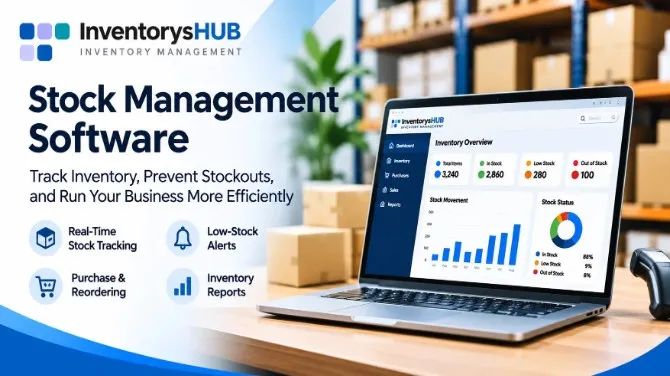
Stock Management Software provides a structured way to organize inventory information and improve warehouse stock control. It helps businesses monitor product quantities, record stock movements, and maintain better visibility into available inventory.
Whether you operate a small storage facility or manage a growing distribution business, an organized inventory process can make everyday warehouse operations more efficient.
Why Warehouse Inventory Control Matters
Warehouse inventory control involves maintaining accurate information about products stored in a facility. It includes receiving deliveries, organizing storage, tracking stock movements, and ensuring the correct items are available when orders need to be fulfilled.
Poor warehouse inventory control can create several problems:
-
Employees cannot locate products quickly.
-
Recorded quantities do not match physical stock.
-
Incoming deliveries are recorded incorrectly.
-
Orders are delayed because items are unavailable.
-
Products remain in storage without being monitored.
-
Purchasing teams order unnecessary quantities.
-
Stock transfers between locations become difficult to track.
These problems can increase operating costs and affect customer satisfaction.
An effective warehouse inventory process helps businesses maintain accurate records and use available storage space more efficiently.
1. Organize Product Information
Warehouse operations begin with knowing exactly what products are being stored.
Businesses should maintain consistent product information, including names, descriptions, SKUs, categories, and relevant specifications.
This is particularly important when warehouses contain similar products in different sizes, colors, models, or packaging quantities.
For example, a distributor may store several variations of the same product. Without unique item codes, employees may accidentally select the wrong variation during order preparation.
A centralized inventory system helps organize product information so employees can identify the correct items more easily.
Clear product records also make purchasing, receiving, and stock counting more reliable.
2. Record Incoming Stock Accurately
Receiving inventory is one of the most important warehouse activities.
When suppliers deliver products, employees need to verify the received items against the relevant purchase information. Product names, quantities, and conditions should be checked before the inventory records are updated.
For example, a business may order 150 units but receive only 140. If the full ordered quantity is recorded without verification, the inventory system will show incorrect stock information.
A consistent receiving process should include:
-
Check the supplier delivery documents.
-
Verify product names and item codes.
-
Count the received quantities.
-
Identify damaged or missing products.
-
Record the accepted inventory.
-
Document any discrepancies for follow-up.
Maintaining accurate receiving records creates a reliable starting point for warehouse inventory control.
3. Track Stock Movements
Products move throughout a warehouse for different reasons. They may be received from suppliers, picked for customer orders, transferred between storage areas, returned, or removed because of damage.
If these movements are not recorded consistently, stock information can become unreliable.
Stock Tracking Software helps businesses maintain better visibility into inventory changes by organizing stock movement records.
For example, when 30 units are moved from a main storage area to a dispatch section, that movement should be reflected in the relevant records.
Tracking these activities helps warehouse managers understand where products are located and investigate unexpected stock differences.
4. Improve Storage Location Management
Knowing how much stock is available is important, but knowing where it is stored is equally valuable.
When warehouse locations are not organized, employees may spend unnecessary time searching for products. This can slow down order picking and increase the chance of selecting incorrect items.
Businesses can improve storage organization by assigning clear location identifiers to shelves, racks, bins, and storage zones.
For example, a warehouse may use a location structure such as:
-
Zone A – Electronics
-
Zone B – Packaging Materials
-
Rack A1 – Small Components
A structured location system makes it easier to identify where products should be stored and retrieved.
Where supported, inventory software can help maintain location-wise stock information.
5. Reduce Picking and Dispatch Errors
Order picking involves selecting the correct products and quantities for customer orders. Mistakes during this process can lead to incorrect shipments, returns, and additional delivery costs.
Warehouse employees need accurate information about product availability and storage locations.
An organized inventory process can help reduce picking errors by maintaining consistent product records and stock information.
Businesses can also introduce simple operational checks, such as:
-
Verifying product codes before picking.
-
Confirming quantities against order details.
-
Separating products by order.
These procedures help improve order accuracy and make warehouse operations more dependable.
Final Thoughts
Warehouse inventory control involves much more than counting products. It requires accurate receiving records, organized storage locations, reliable stock movement tracking, and regular inventory checks.
When these activities are managed through disconnected spreadsheets and manual processes, errors can affect the entire operation.
Stock Management Software helps businesses organize inventory information, monitor stock changes, and improve visibility into available products.
Combined with clear warehouse procedures and employee training, the right inventory management approach can help businesses reduce avoidable errors, improve operational efficiency, and maintain better control over their stock.


